Monday, March 19, 2012

Advice on How to Handle Your Childs GID??

Reading an article kind of piggy backing off of the Barbara Walters documentary, I learned that there are two suggested approaches to handle your child with GID. One approach was the therapeutic approach which was basically getting your whole family evaluated and treated in therapy and b mending the roots of the family that it should dissipate the child's behavior or desire t be the opposite sex. I personally did not like this approach, I just felt that it was pushing beliefs on a child to be somebody that the are clearly not instead of helping them cope with being different that the society gender norms. The second approach was the approach that accommodates the child, basically supporting them and going with their feelings, belief and what felt right to them. I like this approach better because I believe that everyone should be accepted for who they are no matter what they decide or these cases what's inside of them. Even though I do not have and there is little data on the effectiveness of this approach I believe that this can help any child no matter what they're going through not feel alone and depressed. Though the author was reluctant to take a stance, I think that maybe you guys out there should read this article and see what you think!

-Brittani Moorer


Gender Identity Disorder in Childhood: Inconclusive Advice to Parents
Alice DregerThe Hastings Center Report. Hastings-on-Hudson: Jan/Feb 2009. Vol. 39, Iss. 1; pg. 26, 5 pgs

"My Secret Self" A Very Touching Documentary on Childhood GID

I just watched a short documentary that was on 20/20 about transgendered children diagnosed with GID. I found this not only informational, but insightful and personal. I think we can really relate and get a better picture of how the children feel versus what the DSM or scholarly articles "define" them as. I really like that the parents were very supportive of each of their children's decision at a very early stage of their coming out. I think that there was a deeper understanding that these children are not gay per se but they are actually biologically in the wrong bodies. I admire the strength and perseverance of the children and I think that it was a very good watch!

Check it out on YouTube:

My Secret Self with Barbara Walters

-Brittani Moorer

http://www.youtube.com/watch?v=Utpam0IGYac&feature=related

What is a real (wo)man?

I found an article from November 2009 which focused on manhood and the aggression usually tied to it. Two different experiments were conducted; one using 175 undergraduate students at a private university in the Northeast United states, and another using 113 undergraduate students at a large university in Southeastern United states. The first experiment focused on how many action terms were used to describe what a "real man" and a "real woman" are. The second experiment focused on whether situational or dispositional explanations were favored when attempting to explain a persons physical aggression. In both experiments, their hypothesis were supported.

The first experiment was conducted by randomly giving each participant an open ended sentence starting with either "a real man....." or "a real woman.....", which led them to fill in the blank; the sentence fragment appeared 25 times and the participants had to fill out as many as they could in the allotted time. Most of the results were stereotyped, but still varied. An average of 10.5 sentences were filled out (both males and females averaged about the same). Also, the "a real man..." fragments contained more masculine content, and men included a lot more stereotypical content than feedback given from women.

The second experiment was conducted by randomly giving each participant a faux police report about a bar fight between two men (or women) which was caused by one of them stepping in between them and a person of the opposite sex that they were talking to. They were then accused of not being able to pick up the opposite sex, and were then surrounded by a crowd, and then followed by the fight. After reading the fake police report the participants had to answer eight questions, which each could be answered on a 1-7 scale, which determined whether the factor was dispositional or situational. The results shown that males seen the male violence as situational, while women seen the female violence as dispositional. Women stated that their violence usually came from stress, while men said their's was an exercise of control over others.

Also, they concluded that manhood was something easily lost, but hard to gain; that it had to be behaviorally approved by others, while womanhood was something earned biologically/physically. The top three ways for a man to gain approval were to take risks, perform difficult tasks, and/or to do something public.

For me, both of the results did not come as a shock. I could have guessed the results for the second experiment just because of the way my friends talk about other people.

I do not have the link for the pdf file anymore, but I do still have the pdf itself on my laptop. I hope you learned something, seeing as I have not.

-Derek Moskal =]
I have discovered an article written in 1971 regarding the psychological treatment of homosexuals at the time.


"Summary - A random sample of 163 professional therapists in private
practice in the San Francisco Bay Area were surveyed on their attitudes toward
treatment of homosexuals, diagnostic categories, and other matters. Results indicated
a majority had some (limited) experience with (predominantly male)
homosexuals, most would use but few preferred group therapy for homosexuals,
treatment goals were mixed, change of sex orientation in treatment was minor,
but belief in its possibility widespread; there was considerable disagreement with
some diagnostic categories, little support for mandatory treatment, near-unanimity
on liberalization of the law, widespread support for non-exclusionary employment policies."

Here is a link to the PDF. I hope you will find this as interesting as I did.


-Zachary Tezak


You'd figure that most illnesses and syndromes are universal if there's a book filled with them.  The fact of the matter is that every kind of culture and country has a different diagnosis for things that they consider "abnormal".  Culture plays a huge role in telling society what is a normal behavior and what goes directly into the DSM as being something diagnosable and treatable.  This relates back to Psychology, Gender, and Sexuality in that certain ways of living are up for interpretation.  What is completely normal in one culture (i.e. being slightly depressed all the time in Russia) greatly differs from another culture (i.e. being in a good mood and happy most of the time in America).  This doesn't just apply to larger cultures in regards to countries (i.e. German culture, Italian culture, Islamic culture), but also the culture of individual people living in those countries.

http://rjg42.tripod.com/culturebound_syndromes.htm

Here, you'll find a list of disorders from many different countries that are culture-specific.  It not only lists the disorders and gives definitions, but also goes into the types of cultures these people live in.  Keep in mind what kind of culture these people live in and recognize that to them these disorders are very scary and very real.

Enjoy!
-Emily Gutman

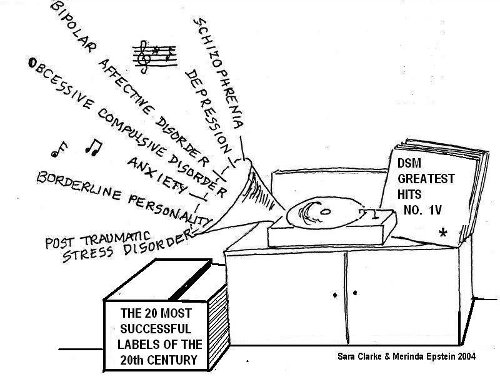
Here's a photo poking fun at and addressing the issue of the popularity of these disorders.  It may be saying that these are the disorders that are the most well known or could be making the point that they are diagnosed way too often.  It is art, so it's up for interpretation.

Another picture that could have been drawn to effectively communicate a similar point is drawing a broken record player.  Out of the bell it would have some of the disorders or even drugs prescribed by psychiatrists written over and over again to make the point that some disorders are diagnosed or some drugs are prescribed way too often.

So what do you guys think the picture is saying?

-Emily Gutman

Saturday, March 17, 2012

Nature vs. Nurture

http://youtu.be/_Osw05HGe5I

This YouTube video was featured on CBS's 60 minutes and discusses the case of fraternal twins Jared and Adam. Jared displays characteristics typical of little boys his age, such as a love for GI Joe toys, guns, and camouflage; while Adam prefers toy horses, baby dolls, pink canopies, and nail polish. Adam displays childhood gender nonconformity, which is the exhibition of behavior favored by the opposite sex. According to research, Adam's behavior puts him at a greater chance of growing up to be gay. The case of Adam and Jared would indicate that homosexuality is not influenced by nurture because the two boys were raised the same way.

Since Jared and Adam are fraternal twins and therefore do not share the same DNA, it would be reasonable to claim the it's genetics that cause Adam to display gay-like tendencies if it weren't for the case of Steve and Gregg- identical twins with different sexualies. Steve is straight while Gregg is gay.

So if its not nurture and its not genetics then perhaps its hormones. Studies done on rats show that male rats injected with female hormones will behave as females, and female rats injected with male hormones will behave as males.

There is also a pattern called "The Older Brother Effect" used to try to explain the appearance of homosexuality in men. According to this theory, the first born son as a 2% chance of growing up to be gay and the next son's chance increases one-third and so on. Strangely, this only applies to right-handed men and does not effect females.

Of coarse none of these findings can be applied to all cases and there are no fool-proof theories, but perhaps these studies will one day lead to solving the mystery behind one's sexuality.

Please see the video link for more information.

-Amanda Ranusch

Tuesday, March 13, 2012

This is way off the topic of our blog but definitely applies to class.  I believe this may have been mentioned in class, but I recently found an entry on a blog with a video about a documentary on a woman who is in the sex industry for disabled people.


The entry follows:


If there’s one thing that makes some people squirm more than the idea of a functional, happy sex worker it’s the frank discussion of disabled sexuality. And award-winning Australian director Catherine Scott has set out to demystify both in her new documentary, Scarlet Road: A Sex Worker’s Journey.
Dispelling the notion that all working women are either glamorous nymphs or damaged goods in need of salvation, the doco follows the life of self-described “whore” Rachel Wotton –- an attractive, articulate (gasp!) and down-to-earth woman. Making her even more intriguing is the fact she deals almost exclusively with disabled clients.
We meet guys like Mark Manitta, who has been seeing Rachel for seven years after cerebral palsy left him confined to a wheelchair, and multiple sclerosis sufferer John Blades who sadly passed away just days before it went to air. Both discuss the vital role that women like Rachel play in their lives. “People do not understand the difference that sex makes,” said Mark. “Part of having cerebral palsy is spasticity and muscle spasms. I need sex all the time to make my muscles relax. And I like sex.”
The founder of Scarlet Alliance –- the Australian Sex Workers’ Association -– Rachel’s passion for advocacy extends beyond those employed in the industry to include her clients and their families; with some of the most heart-warming moments occurring when mothers discuss the desire for their sons to have an active sex life.
“Part of my reason for doing the film was to wipe away the ‘us and them’ mentality,” said Rachel. “We’re all one car accident away from being in the same position as these guys. Tomorrow we could all wake up out of coma and not be able to eat let alone have sex or touch ourselves. What I say to people is imagine the next time you go to have sex or masturbate having to call your mum and have her organise it all for you.”
Amen, sister.

Here is the link I found this exact post on:
http://cassket.tumblr.com/post/13555728631/if-theres-one-thing-that-makes-some-people-squirm

-Emily Gutman

Saturday, March 10, 2012

A video about Gender Identity Disorder and the DSM, mainly about concerns that people are having with the future of the "disorder".


Some great points brought up in this video:
  • The way the diagnosis stands now is that it is saying their gender identity is disordered.  What is actually disordered is their brain identity and phenotypically how they present or their body is incongruent, or incompatible.
  • If something can be fixed with a physical transformation, then it shouldn't be considered a mental health condition.
It's also important to note that although many of what is said is still relevant to this day, a bit of it may be outdated due to the video being two years old.  For example, committee members may have changed as well as what exactly is going to be happening to GID.

-Emily Gutman